Consumer Units: Everything You Need to Know About Safety, Components, and Selection
This post contains affiliate links. Click here to read my affiliate policy.
Last Updated on May 14, 2026
With some of the oldest housing stock in Europe, the UK faces an uphill battle in providing a consistent and safe residential power supply. Older infrastructure heavily relies on outdated fuse boxes, unable to sustain higher power loads, requiring hazardous replacements and a common cause for the growing number of electrical fires.
These have steadily been replaced by more reliable consumer unit boxes fitted with miniature circuit breakers (MCBs) to switch off circuits during overloads, and more importantly, residual current devices (RCDs or integrated RCBOs) to prevent injuries or potential fatalities during electrical shocks.
The transition to modern and safe consumer units accomplishes several main objectives: improved protection, enhanced fire safety and meeting higher power demands. These are all requirements clearly defined in the 18th Edition Wiring Regulations, and the updated standard is now mandatory for all new UK homes.
What Is a Consumer Unit?
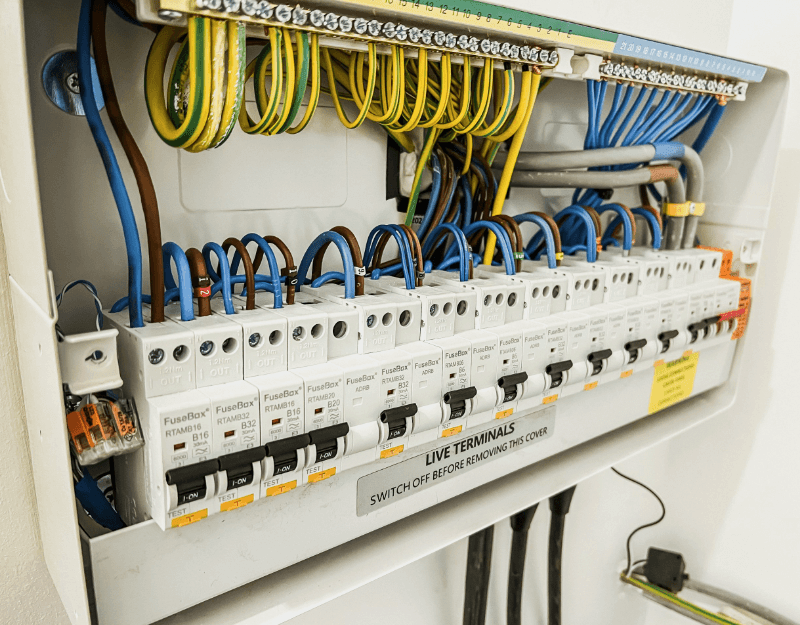
Put simply, a consumer unit is a plastic or metal box that receives incoming power supply from a mains connection and divides it into several circuits that power lights, switches, appliances and devices. Each circuit can be controlled independently, meaning the power supply can be isolated within one part of the home or premises without shutting off power to other parts.
A consumer unit protects individual circuits and all connected appliances during electrical faults, including short circuits, overloads, power surges and earth faults. These events can be a common cause for household hazards, such as electrocution and electrical fires.
Common Components and What They Do
Understanding the individual components in consumer units is essential for general maintenance and operation. This includes:
- Main switch: The main switch allows homeowners and certified electricians to manually cut the power supply, for instance, during an emergency or repairs, ensuring safety.
- Mains (meter) tails: These are large double-insulated cables that bring power to your home from an electrical meter or isolator. They enter the consumer unit and go into the main switch. Newer 100A installations have 25mm2 and older 60/80A installations use 16mm2 cabling.
- Miniature circuit breakers (MCBs): Also called trip switches, MCBs protect individual circuits from overloads and short circuits. A typical UK home will have between 6 and 10 MCBs in the consumer unit, connecting essentials such as lights, cookers, hot water systems and sockets.
- Residual current devices (RCDs): A key difference between older fuse boxes and current consumer units is the inclusion of RCDs. These protect against electrical fires and shocks, cutting the power supply if they detect any current imbalance. Modern homes have at least 2 RCDs splitting the power supply, or 1 RCD per circuit for added protection.
- Residual current breakers with overcurrent protection (RCBOs): These combine the functions of an MCB and RCD into a single device, providing protection against earth faults and overcurrent. Their key benefit is saving space within the consumer unit without forgoing comprehensive protection. Modern homes can have between 6 and 14 RCBOs, as well as RCBOs working in conjunction with MCBs.
- Arc fault detection devices (AFDDs): AFDDs detect arcing in circuits, often from damaged or loose cables or connections, thus protecting installations from fires. While not as common in homes, AFDDs are mandated in larger commercial premises, such as care homes and multi-occupancy buildings.
Additional components include:
- Surge protection devices (SPDs): These protect installations from sudden voltage surges (common in lightning strikes or grid issues).
- Copper busbars: They distribute power from the main switch via RCDs to circuit breakers.
- Earth bars or main earthing terminals: They hold all the circuit protective conductors, the neutral terminal bar connecting neutral conductors and separate circuit cabling that connects lights, sockets, and appliances.
Signs You Need a Consumer Unit Upgrade
As a central hub for electrical circuits, consumer units must be tested and inspected by qualified electricians at least once every 10 years in owner-occupied homes, and every 5 years for rented properties.
Inspections ensure compliance with current wiring standards, optimise performance for lower energy bills, and, importantly, ensure safety and that electrical and appliance failures don’t lead to unwanted outcomes. Electricians can upgrade a consumer unit in the following cases:
- Presence of rewirable fuses: Replaceable fuses that require manual rewiring have slower reaction times when detecting faults, meaning a greater risk of fires, electrical shock and surges. They also provide limited protection for sensitive electronics, upping costs for device repairs or replacements. Newer circuit protection devices offer more comprehensive protection and are mandatory in recent builds.
- Absence of RCDs: The 18th Edition Consumer Unit Regulations stipulate that all homes must have RCD protection devices. These detect earth leakages within milliseconds, greatly reducing the risk of fatal electrical shock in common wet areas such as bathrooms and kitchens. Electricians will install compatible RCDs or rewire the consumer unit with RCBOs.
- Burning Smells and scorch marks: Burning smells and discoloured plastics are signs of arcing or overheating, usually from overloads, frayed and damaged wiring, or loose connections. Again, new regulations state that current consumer unit exteriors must be constructed of non-combustible materials (such as steel), have fire-resistant internal designs and preferably include AFDDs.
- Frequent tripping: Tripping indicates that the installation is struggling to manage power loads. Systems that are often pushed beyond capacity will trip to prevent overheating or fires, and this leads to deteriorating components that eventually must be replaced.
- Future proofing and increased capacity: With rising power needs, households benefit from increased capacity, ensuring the addition of new circuits and appliances without overloading. Protective devices also safeguard expensive electronics in the event of power surges.
Choosing the Right Consumer Unit for Your Needs
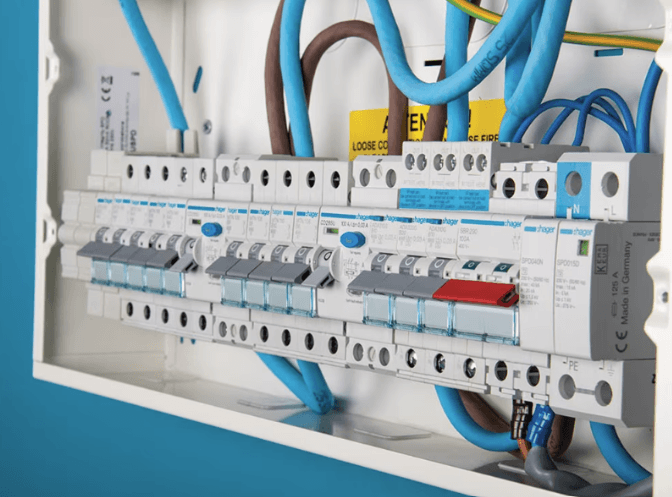
Regulatory compliance, capacity, and suitability are the main considerations when buying a consumer unit. Complying with 18th edition consumer unit regulations means the inclusion of RCDs and fire-resistant materials to prevent fires and electrical shocks in the event of surges, overloads and faults.
Capacity refers to the number of individual circuits a consumer unit can safely manage and distribute. The physical capacity, or number of “ways” correlates with installed circuits. To future proof homes (such as adding chargers for EVs or backyard tool sheds) means you’ll what another 15-20% additional ways when power needs rise. Moreover, electrical capacity, or the amperage that can flow safely through the main switch, determines the maximum total power a home can use at any given time before tripping. Newer installations tend to be rated for 100A, and more than enough even for larger homes.
Lastly, suitability refers to choosing the right consumer unit for the application. The most popular and cost-effective choice for domestic installations is dual RCD consumer units, consisting of a main switch and two RCDs, essentially splitting circuits into two separate banks. These perform better than basic mains switch units, relying solely on the main switch to cut power when needed.
Move up to high-integrity types for maximum protection and flexibility with a balanced mix of RCDs and RCBOs for each circuit to considerably reduce the likelihood of nuisance tripping. You can also combine dual RCD units in homes with separate RCD incomer units in garages, offices and workshops to disconnect circuits independently of the main switch.