How to Plan the Perfect Atacama Desert Trip
This post contains affiliate links. Click here to read my affiliate policy.
Last Updated on July 8, 2026
The Atacama Desert doesn’t operate like other travel destinations. At over 2,000 meters elevation in most areas, with some excursions climbing past 4,000 meters, this is a landscape that demands more preparation than a typical vacation. Get the planning right, though, and you’ll see salt flats that stretch to the horizon, geysers that erupt before sunrise, and night skies so clear that NASA tests Mars rover equipment here. Here’s how to put together a trip that actually works.
Decide When to Go Based on What You Want to See
June through August brings winter to the Atacama, with daytime temperatures around 68°F (20°C) but nighttime lows that can drop below freezing, especially at higher elevations like the El Tatio geysers. This is peak season for stargazing since the skies are driest and clearest during these months. December through February is summer, warmer overall, but also when occasional rainfall in the Altiplano region can make some roads temporarily impassable.
Shoulder months like September, October, and April tend to offer a middle ground: comfortable temperatures, fewer crowds, and stable road conditions. If astrophotography is the priority, aim for a new moon phase regardless of season, since a full moon washes out the fainter stars and the Milky Way’s detail.
Base Yourself in San Pedro de Atacama
San Pedro de Atacama is the small town that serves as the launching point for nearly every excursion in the region. It’s not fancy — dusty streets, adobe buildings, a handful of restaurants — but its location puts you within driving distance of the Valle de la Luna, the Tatio geysers, and several high-altitude lagoons.
Book accommodations here rather than trying to base yourself elsewhere in the region. Options range from simple hostels to upscale desert lodges with observatories on-site, but almost everything worth seeing radiates out from this one town.
Budget at Least 4 to 5 Days
Two days isn’t enough to see the Atacama’s range without exhausting yourself, especially with altitude adjustment factored in. A 4 to 5 day itinerary allows you to space out early-morning excursions (the geysers require a 4 a.m. departure to catch them active) with lower-key afternoons for acclimatization.
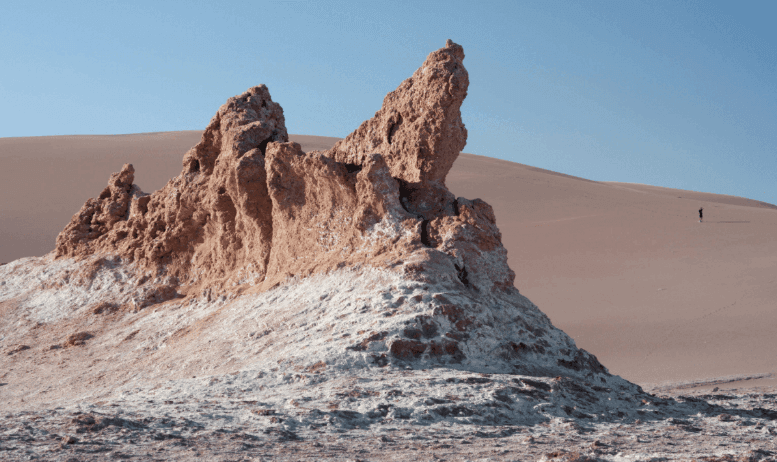
A typical breakdown might look like this: day one for arrival and rest, day two for Valle de la Luna at sunset, day three for El Tatio geysers in the early morning followed by a visit to Machuca village, and day four for the Salar de Atacama and its flamingo-filled lagoons. Day five leaves room for stargazing tours or a visit to the Piedras Rojas rock formations near the Bolivian border.
Plan for the Altitude Before You Arrive
San Pedro sits at about 2,400 meters (7,900 feet), and several excursions push well beyond that. El Tatio is at roughly 4,300 meters (14,100 feet), high enough that altitude sickness is a real possibility even for people who’ve never experienced it before.
Spend the first 24 hours in San Pedro taking it easy: light meals, plenty of water, and no strenuous hikes. Coca tea, sold widely in the region, is a traditional remedy that some travelers find helpful, though it’s not a substitute for proper acclimatization. If you have a history of altitude sensitivity, talk to a doctor about medication like acetazolamide before the trip.
Choose the Right Kind of Tour for Your Trip
Group tours are the default option in San Pedro, and they’re reasonably priced, typically running $30 to $60 per excursion. But they also mean fixed departure times, shared vans, and itineraries that don’t bend for your interests or your pace.
A private Atacama Desert expedition solves that problem by giving you a dedicated guide, a flexible schedule, and the ability to linger at a lagoon an extra 20 minutes or skip a stop that doesn’t interest you. This matters more here than in most destinations, since lighting conditions for photography change fast at sunrise and sunset, and a rigid group schedule can mean missing the exact moment a salt flat turns pink. For travelers with mobility concerns or specific photography goals, the added cost is usually worth it.
Pack for Extreme Temperature Swings
Daytime temperatures in the desert can reach the mid-70s Fahrenheit, while nighttime temperatures, particularly during stargazing tours, can drop to near freezing. Layering is non-negotiable: a moisture-wicking base layer, a warm mid-layer like fleece, and a windproof outer shell will cover most conditions.
Sun protection matters more than most travelers expect, since UV exposure at this elevation is intense even on cool days. Bring a wide-brim hat, SPF 50 sunscreen, and sunglasses rated for high-altitude glare, especially if visiting the salt flats where sunlight reflects off the white surface.
The Real Key to a Good Atacama Trip
The travelers who get the most out of the Atacama are the ones who slow down rather than cram in every possible excursion. This is a desert that rewards patience: waiting for a geyser to erupt, watching a sunset shift the color of a rock formation minute by minute, or simply lying back to watch the stars appear one by one. Build in unstructured time, not just a checklist of sights, and the trip will feel far richer for it.