What Makes Marquise Engagement Rings a Good Option?
This post contains affiliate links. Click here to read my affiliate policy.
Last Updated on June 2, 2026
Selena Gomez announced her engagement in December 2024 with a 5- to 7-carat marquise-cut diamond on a slim yellow gold band. Within a week, jewelers across the United States reported a sharp rise in client requests for the same shape. The marquise cut, dormant since the late 1980s, returned to the conversation overnight.
The shape itself dates back centuries. King Louis XV commissioned it in 1745 to imitate the lips of his mistress, who would later become the most powerful woman at Versailles. The cut’s appeal in 2026 rests on geometry, optical effect, and the current taste for elongated stones.
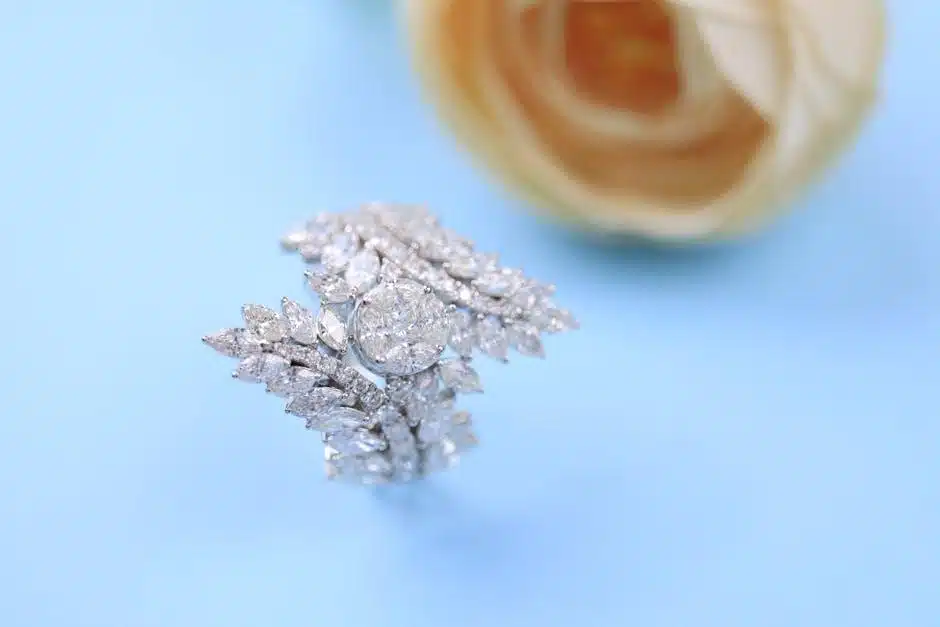
Image source: Pexels
Geometry and Visual Effect
A marquise diamond is an elongated oval that tapers to points at both ends. The proportions follow a length-to-width ratio between 1.75 and 2.25, with the most common falling near 2.0. At equal carat weight, the cut produces a face-up surface area roughly 15 percent larger than a round brilliant, which makes the stone appear bigger without costing more.
The effect on the wearer’s finger is the marquise’s chief argument. The long axis of the stone extends parallel to the finger, drawing the eye along its length. The effect is most pronounced on shorter or wider fingers, where it lengthens the visual line by an average of half an inch in photographs. On long fingers, the cut adds drama, and the lengthening effect matters less.
Facet structure is the brilliant style, with 56 to 58 facets cut on the same principle as a round brilliant. Light enters the table, refracts off the lower pavilion facets, and returns through the crown. The two points add complication. They concentrate the light and create the bow-tie shadow at the center of the stone, which any modern marquise must be cut to minimize.
Choosing a Marquise Over Other Shapes
A marquise diamond ring belongs to the same family as oval and pear shapes, with the longest visual line of any single stone at equal carat weight. The shape also asks for more careful daily handling than the round brilliant, since the two points can chip if struck against a hard surface.
The choice between marquise and a less elongated cut comes down to two priorities. The wearer who prizes the visual length accepts a routine of checking the point prongs every two years.
Durability and the Point Problem
The two points of a marquise diamond are the structural weak spots. A point that catches the edge of a door frame or a kitchen counter can chip, and the chip can run a fracture line back toward the table. Cutters address this by leaving a thicker girdle than is typical for other fancy shapes and specifying a V-tip prong setting that fully encloses each point.
The setting choice has the heaviest weight in long-term durability. Two V-tip prongs at the points and four standard prongs along the sides is the standard protective configuration. The prongs need a check every two years. A prong that has thinned to half its original thickness will not catch the stone if it slips during cleaning.
A Smithsonian curator studying the cutting history of historic stones has documented how the same vulnerability shows up across every era. The points face the same risk on a museum-grade stone as on a one-carat shop diamond. The cutter’s job is to balance maximum length against minimum exposure at the tips.
Style Pairings and Setting Choices
The shape pairs well with the geometric vocabulary of the Art Deco era, which made heavy use of pointed and elongated stones in the 1920s and 1930s. A marquise center stone set in a platinum frame with baguette side stones and milgrain edging produces a period-correct Art Deco silhouette.
Halo settings work but require care. A standard round-halo would muddle the marquise’s line. A halo that follows the outline of the stone, a marquise-shaped halo, strengthens the line and adds visible carat weight at the table.
Three-stone settings split into two camps. Side stones in a tapered baguette shape echo the points of the center stone and produce a flame-like profile. Side stones in a smaller marquise create an obvious echo, sometimes too literal. Round or oval sides give the most contrast and are the safest choice when the buyer wants a strong visual hierarchy.
Solitaire is the third standard choice. A bezel setting fully encloses the stone in a thin metal band. The setup protects the points well, though it dampens the brilliance because some of the light returns through metal rather than through the crown.
Origin and Modern Resurgence
The marquise cut traces to 1745, when Louis XV commissioned a Paris jeweler to produce a diamond shaped to imitate the mouth of his new mistress, Madame de Pompadour. The original stone has been lost, but the shape entered the French court and spread to the aristocracy. The name marquise referred to her rank, and the cut became identified with the woman who inspired it.
Pompadour’s role at court extended beyond her relationship with Louis XV. She served as his minister of the arts in practice, directing royal commissions in architecture, porcelain, painting, and decoration, including the founding of the Sèvres factory. The cut named after her reflected the aesthetic that defined French taste under her direction.
The shape moved in and out of favor across the next two centuries. It dominated the Art Deco period and faded in the 1950s, returning briefly in the 1980s before going dormant for thirty years. The current resurgence began with Selena Gomez’s December 2024 engagement, when a 5- to 7-carat marquise diamond on a slim band reset the trend forecasts for 2026. Within months, the cut moved from a vintage curiosity to a primary choice for new buyers.
A Buyer’s Checklist for the Cut
The marquise is an elongated brilliant cut with the longest visual line of any single stone, the most flattering effect on a wide range of hand shapes, and the highest vulnerability at the two points. A buyer who handles the daily care and selects a setting designed for point protection gets a stone that looks 15 percent larger than a round brilliant at the same carat weight.
The practical buying checklist comes down to four items. Look for a length-to-width ratio between 1.85 and 2.10 for the most balanced silhouette, a girdle thickness graded medium or slightly thick, a V-tip prong setting at both ends, and a written commitment from the jeweler to inspect prongs every two years at no charge. A buyer who verifies those four items has the right marquise.